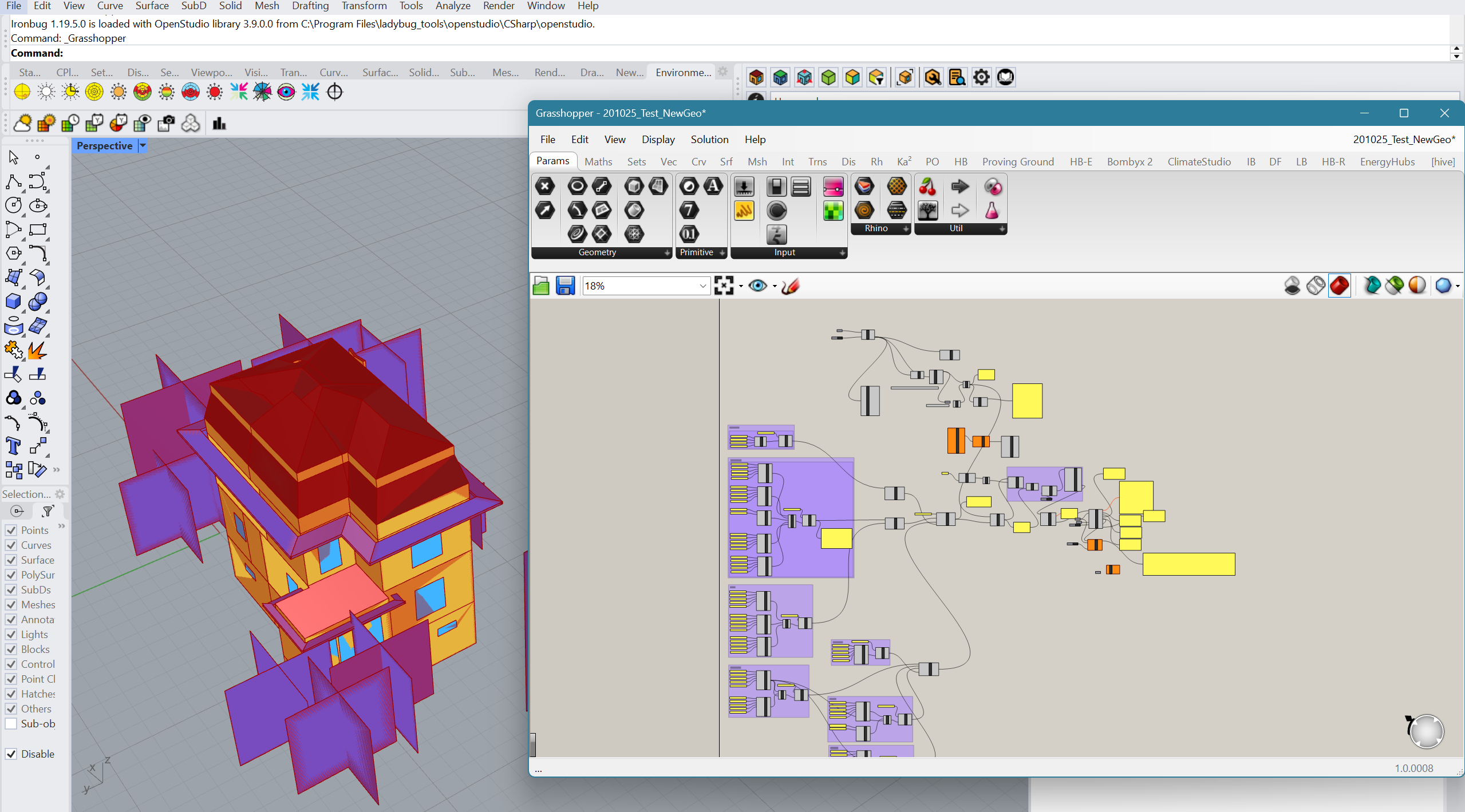
Hi @mostapha Thank you very much! I’m happy that the interior roof faces allows the model to be so accurate. I was able to check the .pomf file you sent and replace my old geometry (the initial model I sent on this thread) in HB. I would really like to know how you resolved the issue of the “flat attic” volume and the dormer extrusions though so I can troubleshoot myself next time. Was it just about the roof alignment and the interior roof faces?
Also, would you know if HB recognizes the room volumes that are set via revit/pollination as energy zones or do we need to set them manually (by deconstructing by face/room)? I was trying to do this today and got stuck…
I should add, the Revit-Pollination-HB workflow has never been smoother!
I’ll write a longer answer tomorrow with some screenshot. But one possible solution is to save the model as an ‘HBJSON’ file and then use the Load Objects component to load the full model to Grasshopper.
Yes, @mostapha that’s the component I used already in my script and loaded the full geometry to HB using the .hbjson exported from pollination ( that’s the screenshot attached in the message above). I’ve already set the construction sets, but was at the stage to assign the systems and schedules to “energy zones” which I need to set first. Since I’m not deconstructing the model or doing it in rhino/GH by setting breps as energy zones, I wanted to understand if the HB model can use the room volumes from the hbjson and recognize them as energy zones or something.
Hmm. I’m not sure if I fully understand your question here. Sorry!
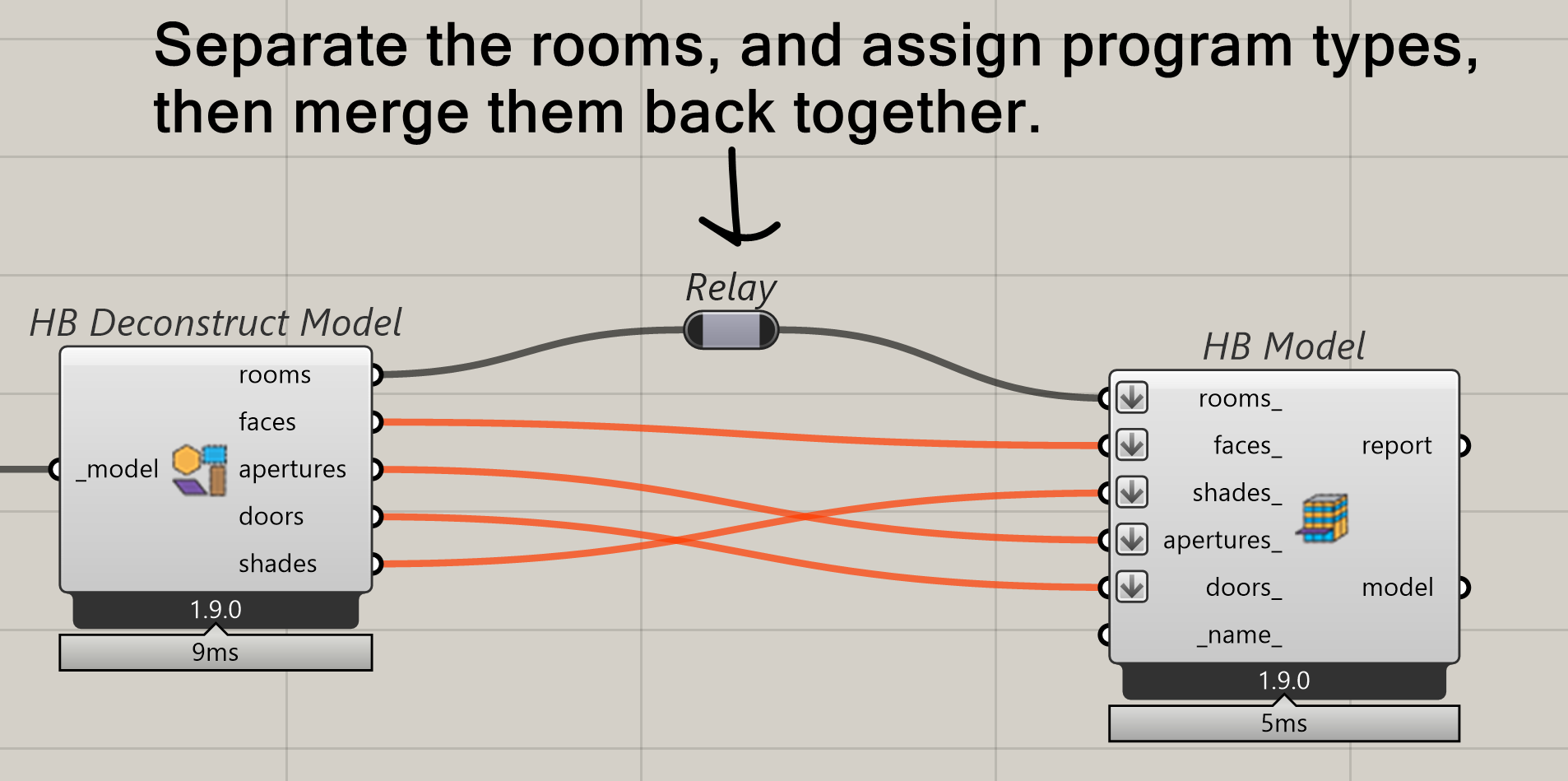
Why don’t you deconstruct the model to access the rooms? And then put them back together as a model? You can assign the program types, and then put the model back together.
Another option is to use the Pollination Rhino plugin instead. Which will simplify your Grasshopper script by a lot since you can assign all the properties to rooms inside the Rhino plugin. In that approach you can bring the full model with all the properties into Grasshopper and run the simulation. I would only recommend using Grasshopper for cases that you need some parametric studies or automation that is slower to do in Rhino.
The video that is linked here covers some of the main workflows to use the Rhino plugin with Ladybug Tools inside Grasshopper.
Hi @mostapha, thanks for this, I have to do a fully parametric study in Honeybee, that’s why I didn’t want to take it to Rhino. But I did test the pollination rhino in an alternate workflow for the same project for a bit. And I was able to use the .hbjson exported from the pollination model with the pipeline you suggested here and it recognised the rooms inside Honeybee after deconstructing the model, which was great. Thanks.